
Cyber crime is escalating fast – in both complexity and impact. Every week brings news of a new breach, ransomware incident, or sophisticated social engineering campaign. While the complexity and impact of cyber incidents keep evolving, one constant remains: your people are still your strongest line of defence. Yet even as cyber security budgets soar, the talent shortage deepens.
This imbalance presents a growing challenge for CISOs, CTOs, and HR leaders alike. The reality is stark: tools alone can’t secure an organisation. Without skilled, capable people behind them, even the best defences will fail. That’s why many organisations are turning their attention to skills frameworks – structured, evidence-based models that define what capability looks like, how it can be measured, and how individuals can develop and demonstrate it throughout their careers. And at the centre of this movement for cyber skills stands the (CIISec) Skills Framework.
The CIISec Difference
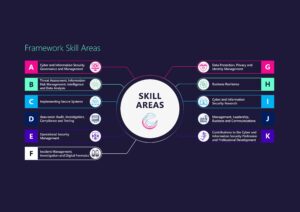
As the UK’s professional body for cyber security, CIISec has developed a skills framework that is the benchmark for defining what “good” looks like in cyber roles – across both technical specialisms and professional behaviours. Unlike some frameworks that take a purely academic view of skills, CIISec’s model was built by cyber professionals and reflects the realities of how security teams operate in practice, from the SOC to the boardroom. At its heart, the framework defines the knowledge, skills, and behaviours needed across the full spectrum of cyber security disciplines – from governance and threat management to incident response, forensics, and leadership. It’s structured in a way that makes sense to both individuals planning their careers and organisations seeking to build resilient, capable teams.
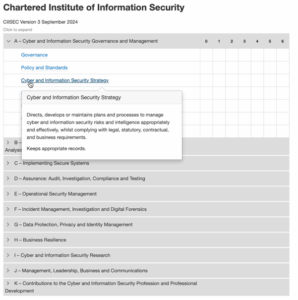
The CIISec framework provides the credibility organisations need to build capability with confidence. It gives individuals a clear picture of their professional standing and a defined pathway to advance.
Its value in addressing the cyber skills gap lies in the framework’s ability to be used in three critical areas:
-
- Recruitment – building clear role job profiles using skill definitions and levels that help organisations hire effectively
- Development – developing career pathways to drive structured professional growth
- Validation – providing independent accreditation and chartered status, recognised across government, defence, and enterprise sectors
In practice, the CIISec Skills Framework gives both leaders and practitioners a common language. It turns skills conversations from subjective opinions into measurable progress, helping align HR, L&D, and cybersecurity leadership on the same development goals.
Bringing Order to Complexity
The scope of what constitutes a “cyber role” has expanded dramatically. Cloud architecture. Privacy. Digital forensics. Threat intelligence. The boundaries between disciplines are increasingly blurred. Without a shared framework, job descriptions vary wildly – leading to mismatched hires and unclear responsibilities.
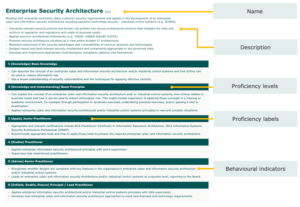
CIISec’s skills framework cuts through the confusion. Each skill area is defined with precise statements of what effective performance looks like at different levels of proficiency. These levels are aligned to real-world expectations – not just technical knowledge, but the ability to apply that knowledge responsibly and effectively.
For organisations, this clarity helps to deliver:
- Coherent job role profiles that reflect genuine capability requirements
- Identification and closure of skill gaps across teams and functions
- Targeted learning and development plans aligned with strategic priorities
- Demonstrable proficiency and readiness to regulators, clients, and insurers
For individuals, CIISec offers a transparent route to professional growth. Practitioners can see where they stand today, understand what’s expected at the next level, and access development opportunities that genuinely advance their careers.
By focusing on the behaviours and outcomes associated with each level of expertise, CIISec encourages a mindset of professional accountability. It moves beyond the question of what someone knows and focusses on how effectively they can apply that knowledge in real-world situations.
CIISec and SFIA: Better Together
For many organisations, the Skills Framework for the Information Age (SFIA) has long been a trusted model for defining IT and digital capability. SFIA provides a broad structure for skills across seven levels of responsibility, covering everything from software engineering to service management. When it comes to cyber security, however, CIISec provides the specialist depth that complements SFIA’s broader view. Together, they form a powerful combination: SFIA defines the breadth of digital capability, while CIISec defines the depth of cyber expertise.
This alignment allows organisations to use SFIA for enterprise-wide consistency while leveraging CIISec for detailed cyber role definition. The result is a joined-up approach that connects HR strategy, technical excellence, and professional standards.
For example, a CIISec-accredited Security Operations Manager can have their skills mapped directly to SFIA’s relevant levels – providing consistency in role alignment while maintaining cyber-specific precision.
How CIISec Cuts Cyber Risk Down to Size
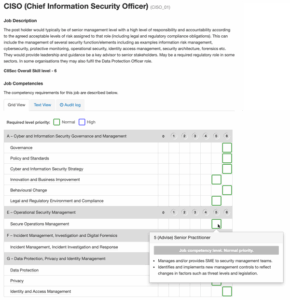
Using CIISec isn’t about ticking a box. It’s about building genuine capability – and closing the human side of the cyber gap. Here’s how the CIISec Skills Framework transforms vulnerability into strength:
- Build role clarity that actually strengthens resilience
Without frameworks, job descriptions become guesswork. CIISec brings structure and precision, defining precisely what’s needed at each level. The result? Better alignment, faster ramp-up, and stronger, more resilient teams that know exactly what’s expected of them.
See Example CIISec Work Role with Skill Mappings in the Lexonis TalentScape platform
- Hire for skills, not just credentials
Move beyond credential-chasing. CIISec defines the essential skills required for each role with clear, evidence-based benchmarks. This approach ensures candidates can demonstrate capability in practice, not just on paper – eliminating blind spots before they become vulnerabilities.
- Give your talent a future worth staying for
With clear progression mapped through CIISec levels, you show your cyber professionals a defined future within your organisation. This visibility drives motivation and engagement, which are critical in a high-pressure, high-turnover field where retention is as important as recruitment.
- Turn compliance into a competitive advantage
Regulators and insurers increasingly demand proof of capability. The CIISec framework allows you to document workforce competence, development, and readiness in a structured, repeatable way – transforming assurance from an afterthought into an integral part of your capability story.
From Assessment to Action: Your CIISec Roadmap
Implementing the CIISec framework doesn’t need to be complex. Many organisations start small – focusing on priority roles such as threat analysts, incident responders, or vulnerability managers – and then scale gradually as capability matures.
A practical roadmap might look like this:
- Map your current roles – identify which positions are critical to your security posture and document the skills they require today.
- Assess skills and identify gaps – use CIISec’s proficiency levels to assess the skills of your team members, then aggregate the results to benchmark where your team stands and where capability needs to grow.
- Align training and development – create targeted learning plans that connect individual development to organisational priorities.
- Track progress and impact – measure improvement over time, linking skills development to security outcomes and business resilience.
- Refresh annually – capability building isn’t a one-off exercise. Make CIISec assessment part of your regular talent review cycle.
Building cybersecurity capability is a continuous process. The CIISec framework provides the structure to measure, develop, and sustain that capability year after year.
Beyond Compliance: Building a Culture of Professionalism
Skills frameworks such as the one from CIISec do more than strengthen compliance- they help shape organisational culture. When skills are defined, measured, and recognised, people feel valued. When progression is transparent, development becomes a shared commitment rather than a personal struggle. Adopting CIISec is about building a culture of professionalism – where capability is visible, standards are consistent, and learning is continuous.
Regulators and insurers increasingly seek evidence of workforce capability. A CIISec skills-aligned approach provides that assurance, demonstrating that your organisation is not only technically capable but also professionally accountable.
But the most significant benefit lies in confidence – knowing that your team understands what good looks like, and has the skills, framework, and mindset to deliver it.
People at the Heart of Cyber Resilience
The organisations that thrive in this era of escalating cyber risk will be those that invest in their people as deeply as they invest in their technology. Not just with training. Not just with tools. But with clear standards, defined pathways, and professional recognition.
The CIISec Skills Framework offers a proven path to do just that – turning skills data into strategy, frameworks into careers, and teams into true centres of excellence.
For individuals, it’s a pathway to recognition, growth, and belonging in a profession that never stops evolving.
For organisations, it’s a structure that turns the human factor from vulnerability into strength.
Together with frameworks like SFIA, CIISec is redefining what capability means in cyber security – not just as a set of technical skills, but as a living standard of excellence.
The talent shortage isn’t going away. But with CIISec, you can build the capability you need – one skill, one role, one professional at a time.
The question isn’t whether to act. It’s whether you can afford not to.